“I've Learned to Be Very Direct, They Have Dutchified Me”
Written by: Fit4taal Team
Published: 18/12/2025
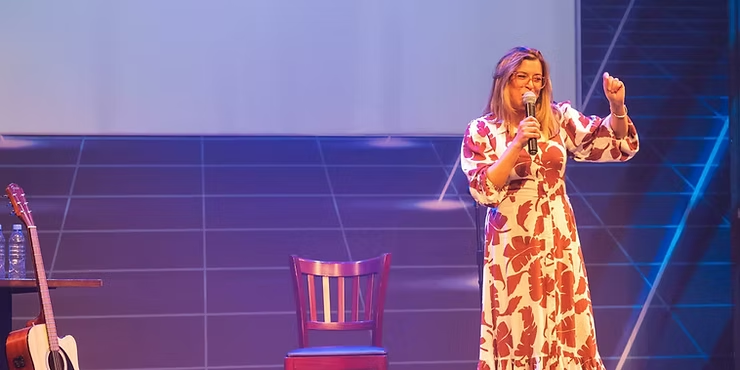
Originally from the Peruvian city of Trujillo, Claudia moved to Amsterdam in the mid-2000s to work as an au pair. She is now an event organiser, hosts the popular Instagram series Latina in the Netherlands, sees herself as an immigrant, and is still amazed by how calm Dutch traffic is.
How did you end up in the Netherlands?
When I was 23, I came to the Netherlands to work as an au pair for a year. During that year I met a friend who would become my partner and later my husband. I never planned to stay in Holland. I expected to go to Spain because my sister lived there and everyone speaks Spanish. That would have been easier for me.
I even thought about going back to Peru, but the circumstances and the situation changed because my husband is Dutch. Moving to another country was not part of his life plans, so I decided to stay here.
How do you describe yourself: expat, lovepat, immigrant, international?
Sometimes it is hard for me to see the differences between the words expat and immigrant. In Spanish, people like me are called expatriados. That is because you leave your homeland only to live in your new host country. However, I came here as an immigrant. I came in search of new opportunities, a better future, a better salary, and a better job. All those are things we do not have in South America and in many other Latin American countries.
What do you think is the difference between an expat and an immigrant? I think an expat is someone who moves to another country for work or study, but is mainly there because they want to live there for a couple of years and then leave. I still consider myself an immigrant.
How long do you plan to stay?
For a long time, probably my entire life, or at least until I retire and maybe move to some island until I die. You know, as a family we have thought about going back to Peru many times, but we have a daughter. She is nine now and it would be hard for her to move, given the circumstances. She has friends and is getting a good education here. It would be difficult to emigrate again with her and my husband. Life in Peru is really different, but also more relaxed.
Recently we were in a period where we worked and worked and worked, and we asked ourselves: “Is this all?!” It is a beautiful country, but we have terrible weather and there are other things that always keep you busy and that is your life. I think the European mindset is like that, and we South Americans are different, at least in that respect.
The pace of life there is slower, more relaxed, and maybe that is why we do not grow as much as a country, you know? Living like that is very relaxing and you do not have as many worries as here. The two countries are very different.
Do you speak Dutch and how did you learn?
I do speak Dutch, yes. I learned at work, speaking at home, and watching a lot of Dutch television. I watched shows like Gooische Vrouwen, Expeditie Robinson, and the news. I did not always watch them; my husband did, but I had to hear them. That was the key for me: listening. You get used to it and suddenly you start thinking in Dutch words. That is when I began to learn the language.
I also read many things in Dutch and was with Dutch people all the time, but I also listened, listened, and listened a lot. I took classes at a school a few times and, believe me, I never learned. It was very boring. I did not like the classes here and they were in the afternoon, only one hour a week. For me, that was not enough.
I only went because I felt that I needed to study, but I was not really learning anything. The classes only helped when I prepared for the inburgeren courses so I could get ready for the exams. The teachers only spoke to us in Dutch.
At the same time, I started working in a place where everyone spoke to me in Dutch. My husband also helped me by speaking to me in Dutch. He said, “Why don’t we only speak Dutch at home?” And that is what we did.
Oh, and I also took conversation classes years later, when I already spoke some Dutch. They helped me a lot with the phonetics of the double vowels. At Fit4taal, the school I attended, they spoke Spanish, which helped me a lot. They could understand me and my native language when I tried to say the “aa,” the “oo,” and the “ou.” They are not the same in Spanish.
What do you like most about Holland?
I love that the Dutch are very practical about everything when it comes to solving problems and making decisions. They do not beat around the bush like South Americans. There people give you a whole introduction before getting to the point. It is like that many times.
Now I think that if someone wants to ask me something, they should just do it and stop talking so much while trying to be nice. Everyone tries to be nice, but I want to tell them: “No, what is the problem? Let’s get straight to the facts and solve it.” I love that about the Dutch.
To what extent have you become Dutch?
I think I have become Dutch after so many years living here. When I go back to Peru, I realise that now I am a planner, like the Dutch. I like to plan things in advance. I am no longer very spontaneous. I even have a diary with a bicycle on it. I have also learned to be very direct, as I mentioned before. I think they have “Dutchified” me.
Another thing I do, when there is not much daylight in winter, is go for wandelingen [long walks]. Over time, I have learned to appreciate the charm of every season in Holland, even winter. You have to make the most of all the light you can get on those days, because otherwise you get depressed. Ah, and I also have dinner at six, not because I want to, but because that is how the Dutch structure their day. They leave work at five, if they have a normal job, and because they do not have a heavy lunch, they want to eat dinner as soon as possible.
Now I do it too and I can no longer eat formal lunches. I eat broodje kaas [cheese sandwiches] at lunchtime, but I do not drink milk with them. This is still an agricultural culture, so that explains the milk and cheese and wooden clogs. It all comes from farming culture.
Name three Dutch personalities (living or dead) you would like to meet:
- Robert ten Brink. He is on the show All You Need is Love. I love it.
- Gordon Heuckeroth. I had to think about this one. I forgot his name. I had to look it up on my phone. I would like to meet him because he is very funny and I love his shows.
- Queen Máxima. If she invited me to dinner, I would go, of course.
What is your top tourist destination?
I always tell people they should go to the Rijksmuseum in Amsterdam. I love it. I also like to take people to Scheveningen. People often say, “Oh, there are no good beaches in Holland,” but there are, and this one is very, very beautiful. I love its wide shoreline. I think it is very special.
Okay, it is not the Caribbean, but when people see Scheveningen they always like it a lot. I am a fan. I also like Noordwijk, which is nearby. I also enjoy walking through the streets of Amsterdam’s Jordaan or visiting a brouwerij where they have good Amsterdam beer.
Tell us something surprising you have discovered about the Netherlands
I think it would have to be the traffic, if I compare it with South America. If you have to choose between driving or walking when the streets are crowded, there is a 70% chance you will die if you walk. It is insane. People, even pedestrians, do not respect any traffic lights or zebra crossings. If you are walking, it is like you are in the Tetris video game.
Here the streets are incredible. They are good and well organised. If there is traffic, everyone is very calm. They do not get angry.
If you only had 24 hours left in Holland, what would you do?
I would probably spend them in Amsterdam, in a nice café or on a beautiful terrace. I would like to enjoy the sun, like all the Dutch do when they can. I love a very old place called Café Thijssen. It is one of the oldest, it is a brown café. I have been going there forever.
Don't forget to share this article

Start your online Dutch course today
Book a free 30-minute trial class and get personalised guidance from your very first contact. Discover your level and the best route to reach your goals in the Netherlands.